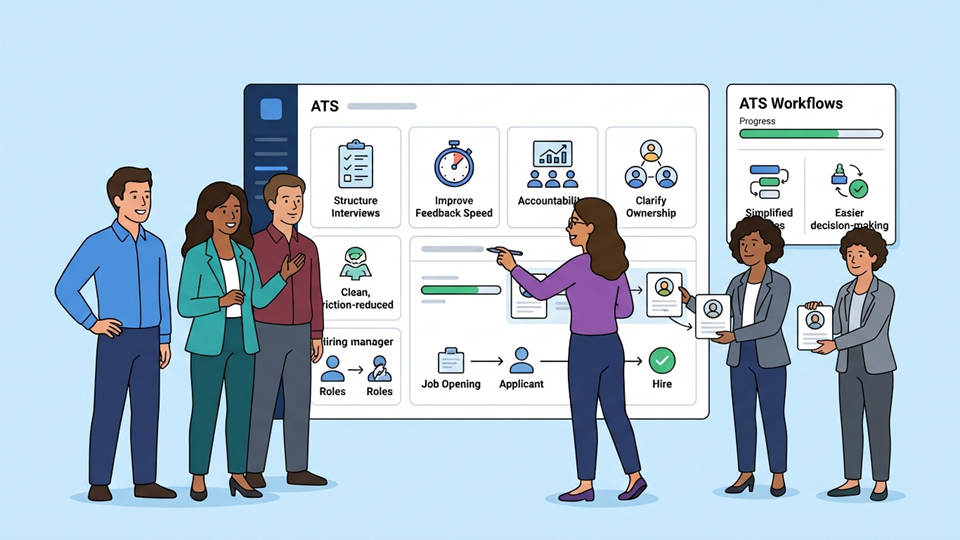
Design the hiring process around how managers actually work
Hiring processes often fail for a simple reason: they are designed by recruitment teams, but a large part of the execution depends on hiring managers. If the process requires managers to remember multiple steps, update several systems, attend unnecessary meetings, or complete long evaluation forms, compliance will deteriorate quickly. The result is usually inconsistent interviews, delayed feedback, poor candidate communication, and recruiters spending time chasing decisions instead of moving candidates forward.
A process that managers actually follow should reduce friction while preserving structure. The objective is not to remove governance. It is to make the expected action obvious at each stage. A hiring manager should know when they need to review candidates, what information they are expected to provide, which competencies they are evaluating, and how quickly a decision is required.
Start by mapping the current process from the manager's perspective. Count the approvals, meetings, interviews, forms, messages, and decisions required for a typical hire. Then identify where managers routinely delay, bypass, or duplicate work. If recruiters regularly copy interview feedback from email into the ATS, or managers send candidate decisions through chat rather than completing scorecards, the problem is not only individual behavior. The workflow is signaling that the approved process is harder than the workaround.
Standardization should focus on the parts that materially affect quality and speed. Role approval, selection criteria, interview responsibilities, evaluation evidence, decision ownership, and response times usually deserve consistent rules. Other elements can remain flexible. A process that controls everything becomes difficult to use, while a process that controls nothing produces unreliable hiring decisions.
Make responsibilities and decision points explicit
One of the biggest causes of recruiting delays is unclear ownership. Recruiters may assume the hiring manager will review a shortlist within two days, while the manager assumes the recruiter will first narrow it further. Interviewers may believe someone else is evaluating a competency, and final decisions can stall because nobody knows who has authority to close the process.
Each hiring workflow should therefore define who owns every important action. The recruiter may own sourcing, initial screening, candidate communication, and process coordination. The hiring manager may own role requirements, shortlist approval, final interview participation, and the hiring decision. Other interviewers should know exactly which competencies or questions they are responsible for assessing.
Service-level expectations can help turn ownership into operational discipline. For example, a company might expect managers to review shortlisted candidates within two business days, interview feedback to be submitted within 24 hours, and final decisions to be made within two days of the last interview. These targets do not need to become rigid rules for every situation, but they establish a shared definition of what a responsive process looks like.
Escalation should also be built into the process. If feedback remains incomplete after the agreed period, the system or recruiter should make the delay visible rather than allowing the candidate to remain indefinitely in the same stage. This is especially important for competitive roles where strong candidates may be interviewing with several employers at once.
Consider a team hiring ten software engineers over a quarter. If every final-stage decision is delayed by three additional days because feedback is incomplete, the company introduces 30 cumulative days of avoidable delay across those hires. The operational impact can be larger when candidates withdraw or accept competing offers during that time.
Use structure without turning managers into recruiters
Hiring managers should participate deeply in candidate evaluation, but they should not need to become experts in recruiting administration. The process should give them structured tools that make good decisions easier while leaving coordination, communication, and pipeline management primarily with the recruitment team.
Structured scorecards are one of the most effective mechanisms. Instead of asking managers for generic feedback, define a limited number of job-relevant criteria and ask for evidence against each one. A sales manager might evaluate commercial judgment, discovery skills, negotiation, and account ownership. A technical manager might assess architecture decisions, problem solving, code quality, and collaboration. The scorecard should be short enough to complete immediately after the interview.
Interview plans should also prevent duplication. If five interviewers all ask candidates about the same experience, the company consumes more time without gaining much additional evidence. Assigning competencies across the interview panel creates better coverage and gives each interviewer a clear purpose.
Templates can reduce preparation time further. Reusable interview kits, scorecards, assessment stages, email templates, and hiring workflows give managers a proven starting point without forcing every vacancy into an identical process. For recurring roles, a template can include the usual stages, interview responsibilities, evaluation criteria, and target timelines, then allow justified adjustments for the specific vacancy.
The same principle applies to approvals. Managers should not need to search through email threads to understand whether a role is approved or which salary range is available. Recruitment systems should keep the current status, responsible approvers, and relevant job information visible in one place.
Build accountability through visibility, not constant chasing
A hiring process becomes difficult to scale when recruiters must personally remind every manager about every action. Some follow-up will always be necessary, but the system should make pending work visible and provide timely reminders before recruiters need to intervene manually.
Dashboards and task views can show managers which candidates require review, which interviews need feedback, and which decisions are overdue. Notifications should be specific and actionable. A message saying that three scorecards are incomplete is more useful than a generic reminder to check the recruitment system.
Recruiting leaders should also monitor manager-related process metrics. Useful indicators include average shortlist review time, interview feedback completion, time from final interview to decision, interview rescheduling, and offer approval delays. These metrics should not be used simply to rank managers. They help identify where the process is creating friction or where additional accountability is needed.
Segmentation can reveal patterns that individual cases hide. If company-wide feedback completion is 92 percent within 24 hours but one department averages only 58 percent, the recruiting team has a specific operational problem to address. The cause may be workload, unclear expectations, unnecessary interviewers, or a workflow that does not match how that department works.
Manager adoption should also be reviewed when hiring outcomes deteriorate. A lower offer acceptance rate, increasing candidate withdrawals, or longer time to hire may not originate with sourcing. Slow manager decisions, inconsistent interview experiences, or repeated scheduling changes can directly affect candidate behavior.
Turn the process into a shared operating system for hiring
The strongest hiring processes create a shared way of working between recruiters and hiring managers. Recruiters provide structure, market knowledge, candidate management, and process control. Hiring managers provide role expertise, evaluation, prioritization, and final accountability. Neither side should need to compensate continually for gaps in the other's workflow.
Regular process reviews help keep that model effective. Instead of redesigning recruitment based on isolated complaints, teams can examine where candidates wait longest, where scorecards are incomplete, which stages produce little decision value, and where managers rely on workarounds. Removing one unnecessary interview or simplifying one approval step can produce more improvement than adding another policy.
Technology should reinforce the process rather than become another administrative layer. An Applicant Tracking System should make the next action clear, centralize candidate information, preserve structured evaluations, automate appropriate reminders, support scheduling, and give managers enough visibility to make decisions without navigating through unnecessary complexity.
Zamdit can support this operating model by bringing jobs, candidates, pipelines, assessments, scorecards, interviews, scheduling, communications, offers, and team activity into a shared recruitment environment. The goal is not to force hiring managers to spend more time inside an ATS. It is to make the correct hiring action easier than the workaround, so managers follow the process because it helps them hire better and faster, not simply because recruitment asks them to.